from the Chicago Teachers Union
Visit ctunet.com/parents for information on the strike authorization vote.

from the Chicago Teachers Union
Visit ctunet.com/parents for information on the strike authorization vote.
from Democracy Now!
As European leaders scramble to address the sovereign debt crisis, Nobel Prize-winning economist Joseph Stiglitz argues the austerity measures pushed by Germany, the United States and international creditors are only “going to make the countries weaker and weaker.” If European economies contract, Stiglitz predicts that “our economy [will] go down further into the hole. … Those policies then increase the probability of our weak economy tipping over into recession.” Stiglitz’s new book is “The Price of Inequality: How Today’s Divided Society Endangers our Future.” Stigliz continues: “Occupy Wall Street was a reflection of a lot of American’s perspective that our economic system is unfair. … There was a hope after the crisis, that government would fix things, it didn’t. Or didn’t do enough, and that combination of economic unfairness and a political system that doesn’t seem capable of correcting these injustices, I think is what motivated a lot of the Occupy Wall Street.”
from the Chicago Teachers Union
Chicago Public Schools parent Matt Farmer puts billionaire Board of Education member Penny Pritzker on trial at Chicago Teachers Union’s Stands Strong rally. Pritzker doesn’t seem to feel it is necessary to provide other people’s children with the same educational experience as hers.
from The Nation
In the years ahead, the country’s aging population will grow to become the largest in US history, says Caring Across Generations Co-Director Ai-Jen Poo. As that happens, the demand for long-term care will skyrocket. “Right now, if you’re aging or if you have a disability, your choices are really limited,” says Poo. “You can go and live in a nursing home or perhaps an assisted living facility, but we want to create more choices so that people can stay in their homes and in their communities, live independently in a context that they know, for as long as possible.”
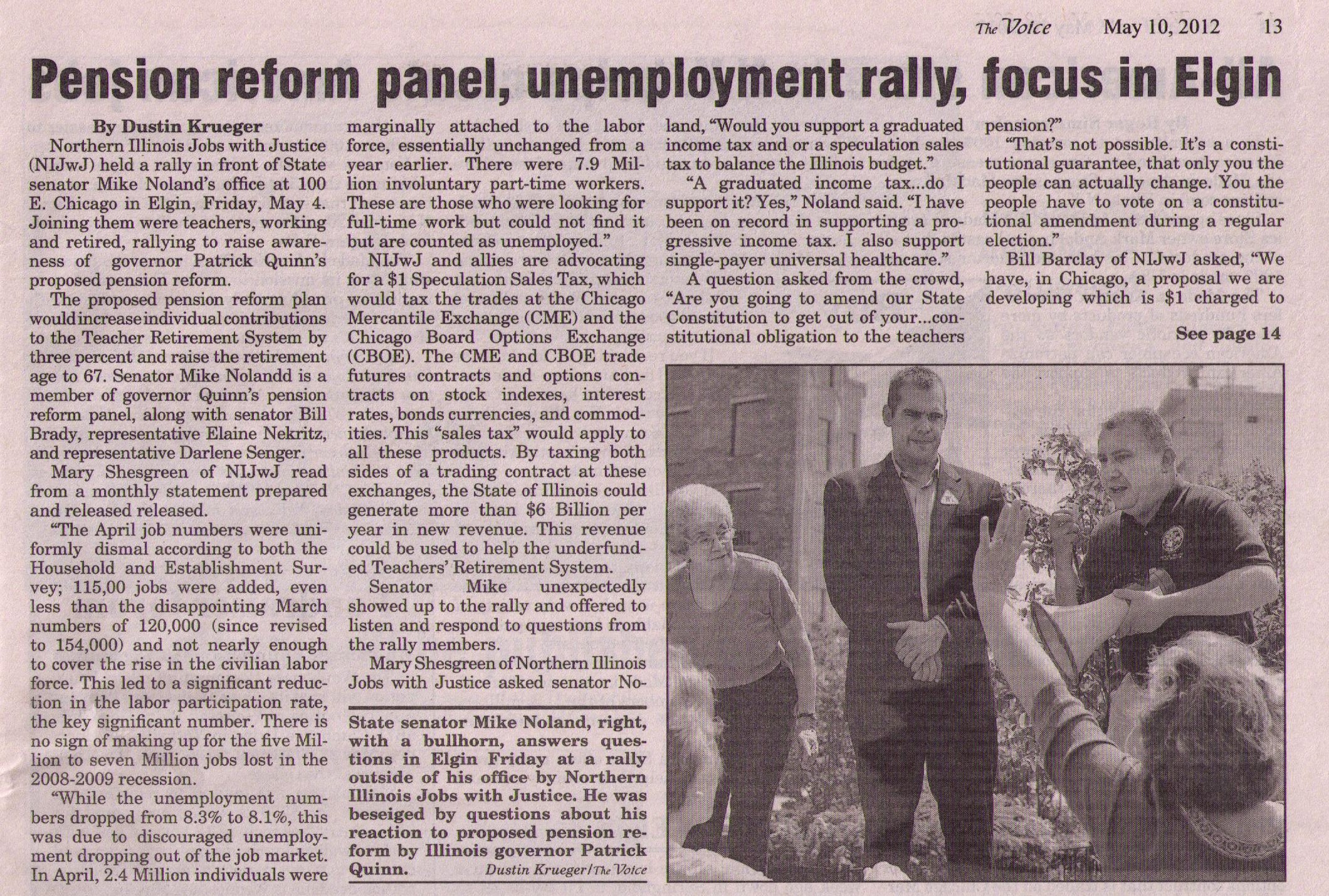
The Northern Illinois Jobs With Justice Coalition held a rally in front of the Illinois State Capitol Building on Tuesday May 29th. The purpose of the rally was to point out the failure of Gov. Quinn, Speaker Madigan and the Democratic Party to lead the state toward a positive solution to the teacher pension issue. In addition, the speakers also pointed out that no one in the House or Senate are broaching the subject of the only real solution to the debt problems of the State-new revenue. The Coalition has put forward several proposals to generate the revenue needed to fund our States’ budget. They include a “graduated income tax”, a “transaction tax” on the Commodities Exchange among other solutions. For more information please contact: www.nijwj.org.
from The Nation
Twenty million people in the United States make less than half of the poverty line, which is about $19,000 per year for a family of three. Another 103 million bring home incomes lower than twice the poverty line. Is this because poverty alleviation programs don’t work, or because we have too many low-wage jobs?
Peter Edelman of Georgetown University Law Center joins Laura Flanders to explain how we became a nation that fails to help its most needy citizens and what can be done.
from the Center for American Progress
Center for American Progress’ Jennifer Erickson, Director of Competitiveness and Economic Growth, describes the Volcker Rule and explains why it needs to be strengthened.
You could identify the politicians at Illinois’ Capital Building by their demeanor. And the same for the lobbyists who were courting their attention. Watching them all was like watching ‘Singles Date Night’ at a local country club. Only instead of alcohol being the drug of choice, it was power and influence. But if you didn’t have the power and influence of either a politician or a lobbyist, the politicians treated you like a peon.
Last week during Illinois’ General Assembly session, people came to Springfield to speak with their Senators and Representatives. They were requesting a seat at the table where changes to the Illinois’ pension system and Medicaid system are being made.
Most of them were teachers and state mental health workers, all worried about cuts their Senators and Representatives were rumored to be planning for their jobs and their pensions. They were easy to identify given they wore green shirts printed with the letters of their union, AFSCME.
The Progressive Fox is proudly powered by
WordPress
Entries (RSS)
and Comments (RSS).

Content on this site is licensed under a Creative Commons
Attribution-NonCommercial-NoDerivs 3.0 License