by Ellen McClennan, posted on Sunday, May 6th, 2012 at 10:06 pm
A group of about forty people from Northern Illinois Jobs With Justice gathered in the noon day sun outside Illinois Senator Mike Noland‘s office in Elgin on Friday, May 4th. The people wanted Senator Noland to hear their concerns about the lack of revenue and funding for Illinois teachers’ pensions. Senator Noland is one of four legislators appointed by Quinn to a task force to solve this issue. While earlier State Senator Mike Noland (D-Elgin) had informed the group he would not be present to respond to their rally, he unexpectedly showed up
John Laesch, from NIJWJ, announced the rally was about the group’s concern regarding the State’s lack of funding for teachers’ pensions, but Noland didn’t seem to understand until the end of the rally that the citizens standing before him had not been sent by the Illinois Education Association (IEA) and were instead concerned citizens and workers—about half of whom happened to be teachers.
“This is a workers’ issue. And we are concerned that our legislators have not funded our teachers’ pensions. We have a revenue problem here. This is a concern to all taxpayers and to all people who work for a living,” said Laesch.
A real movement is not limited to a small party. A real movement touches everyone. In Wisconsin, a real movement did just that. In this video, John Nichols explains how the state came together—from the young to the old, from the private sector to the public—in a show of diversity that formed the basis for a broader struggle.
Obamacare is under threat by the Supreme Court and conservatives in Congress. If the law were struck down or repealed, it would have dire consequences for the millions of women who benefit from it. Jessica Arons, Director of the Center for American Progress’s Women’s Health and Rights Program explains.
The short-term work of strikes and sensational displays of worker power will not be enough to dislodge capitalism’s grip on our lives, says Professor Gayatri Spivak of Columbia University. These short-term tactics must be paired with the longer-term efforts of education and organization. This educational work, Spivak insists in this video, is “not really the pedagogy of the oppressed, it is indeed the pedagogy of the liberated, because if you do not have training in the practice of freedom, when you win… it will not last.”
by John Laesch, posted on Wednesday, May 2nd, 2012 at 7:59 am
State Rep. Daniel Biss had the courage to hold a town hall meeting to discuss “pension reform” in Glenview on April 30th. I estimate that 200-225 people attended the overcrowded room that was set up to accommodate 75 people.
The standing room only crowd was a mirror image of other pension discussions happening around the state. The general mood of the cramped, “slightly too warm for comfort” room was polite and respectful. Biss set the tone by taking questions and respecting diverse opinions while facilitating the conversation artfully.
I attended the event because I felt that if Representative Biss had the courage to hold a controversial town hall meeting that he might also have the courage to lead a fight to actually fund pensions and uphold the state’s end of the deal.
On Tuesday, May 1st, known as May Day or International Workers Day, Occupy Wall Street protesters hope to mobilize tens of thousands of people across the country under the slogan, “General Strike. No Work. No Shopping. Occupy Everywhere.” Events are planned in 125 cities. We speak with leading social theorist David Harvey, distinguished professor of anthropology at the Graduate Center of the City University of New York, about how Occupy Wall Street compares to other large-scale grassroots movements throughout modern history. His most recent book is “Rebel Cities: From the Right to the City to the Urban Revolution.”
by John Laesch, posted on Saturday, April 28th, 2012 at 12:24 pm
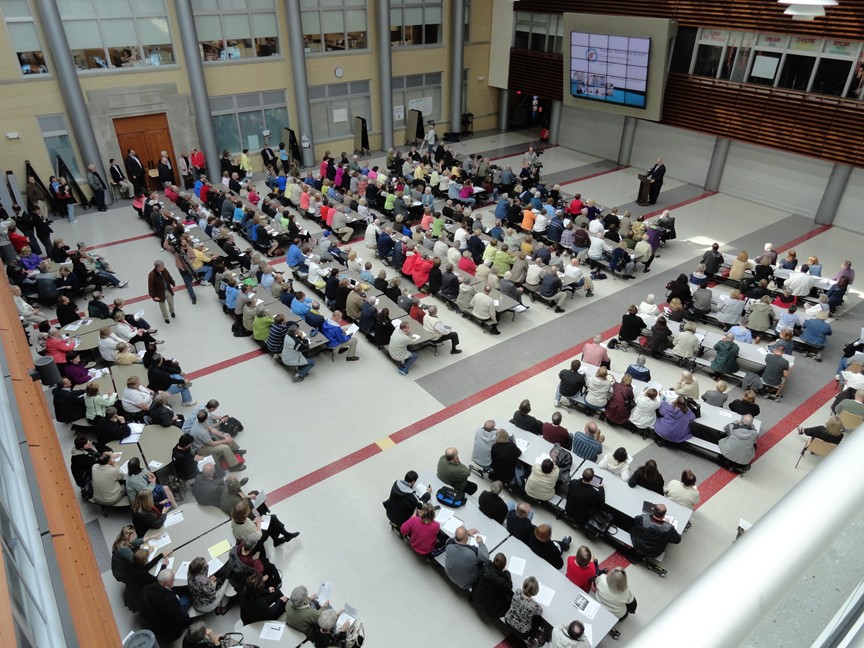
Teachers and retired teachers filled a school cafeteria in Naperville, IL to hear a presentation from Dick Ingram, the Executive Director of the Teachers Retirement System (TRS) on Thursday, April 26th.
The staff at the high school had to set up extra seats to accommodate an estimated 300-400 people.
The presentation itself was very “matter of fact” and seemed to be a part of a PR effort to let teachers know that Governor Quinn and the Illinois General Assembly were about to deliver a hard-hitting punch. Most of the information presented was not new, but the use of multiple events and participation by the news media re-enforced the message, “the sky is falling and teachers have to make concessions.” Before delivering the bad news, Ingram did talk about how great it was that teachers had lived up to their responsibility by paying into the retirement system all of these years. He also acknowledged that teachers are not eligible for Social Security (a point that is often missed by the public and seems to be ignored by lawmakers).